
I’ve Been Told to Just Feel My Feelings, But No One Told Me How
To my fellow human,
Maybe you feel too much and don’t know where to put it all, or maybe you’ve gone a little numb. Maybe you’ve been told, again and again, to just let yourself feel, and you’ve tried, and it still doesn’t work. If any of that is you, you’re not doing it wrong. You were just never handed the instructions because most of us weren’t.
We feel emotions all day long, yet most of us were never taught the simplest things about them: what they are, why they show up, and what to do when they arrive. So let’s start there, and look at what it is to feel.
Let this post be a map you can return to, rather than something to absorb all at once.
Turns out we were told only half the story
Here’s where it all begins: your emotions carry information. Every one of them is a kind of messenger, turning up with something to tell you. And this is the part most of us were never taught. It’s not only that we have many emotions; we have different kinds of emotion, and each kind carries its message differently. We tend to grow up thinking an emotion is just an emotion, you feel it, and that’s that. But once you can tell the kinds apart, a lot of what felt confusing starts to make sense. To make them easier to hold onto, I’ll use a simple metaphor for each.
1. Primary adaptive emotions, the postman

Your raw, immediate, unfiltered response to what’s happening right now. Like the postman, it shows up with a real message about what’s happening, hands it to you, and once you’ve taken it in and acted on it, it goes on its way.
2. Primary maladaptive emotions, the postman with old mail

An old feeling-memory reacting directly to the situation, the past replaying as if it were now. It’s the postman still delivering the same old letter, written years ago, again and again, no matter what’s actually happening at your door today.
3. Secondary emotion, reacting to the postman instead of taking the letter

This one is your reaction to the postman who’s already at your door. A reaction to your own inner experience: your feelings, thoughts, needs, behaviours, or actions. The postman arrives with the real message, but instead of taking the letter, you react to him, you slam the door, snap at him, hide, or burst into tears at the sight of him. That reaction is a feeling of its own, and it won’t let the real message through, because what’s underneath felt too raw to face. So you’re left dealing with your reaction at the door, while the letter it’s covering stays unopened.
4. Instrumental emotion, the salesperson

An emotion we show to produce an effect or reaction in someone else, usually a survival strategy learned long ago, a way of getting a need met indirectly because at some point asking directly didn’t feel safe or didn’t work. Like a salesperson, it rings your bell and puts on a display, not to deliver anything to you, but to get something from someone else. Sometimes you know just what it’s after, and sometimes you can’t tell why it’s there at all.
Now that you’ve met the whole cast at your door, let’s see what they look like in real life.
What these emotions look like
when we let them do their job
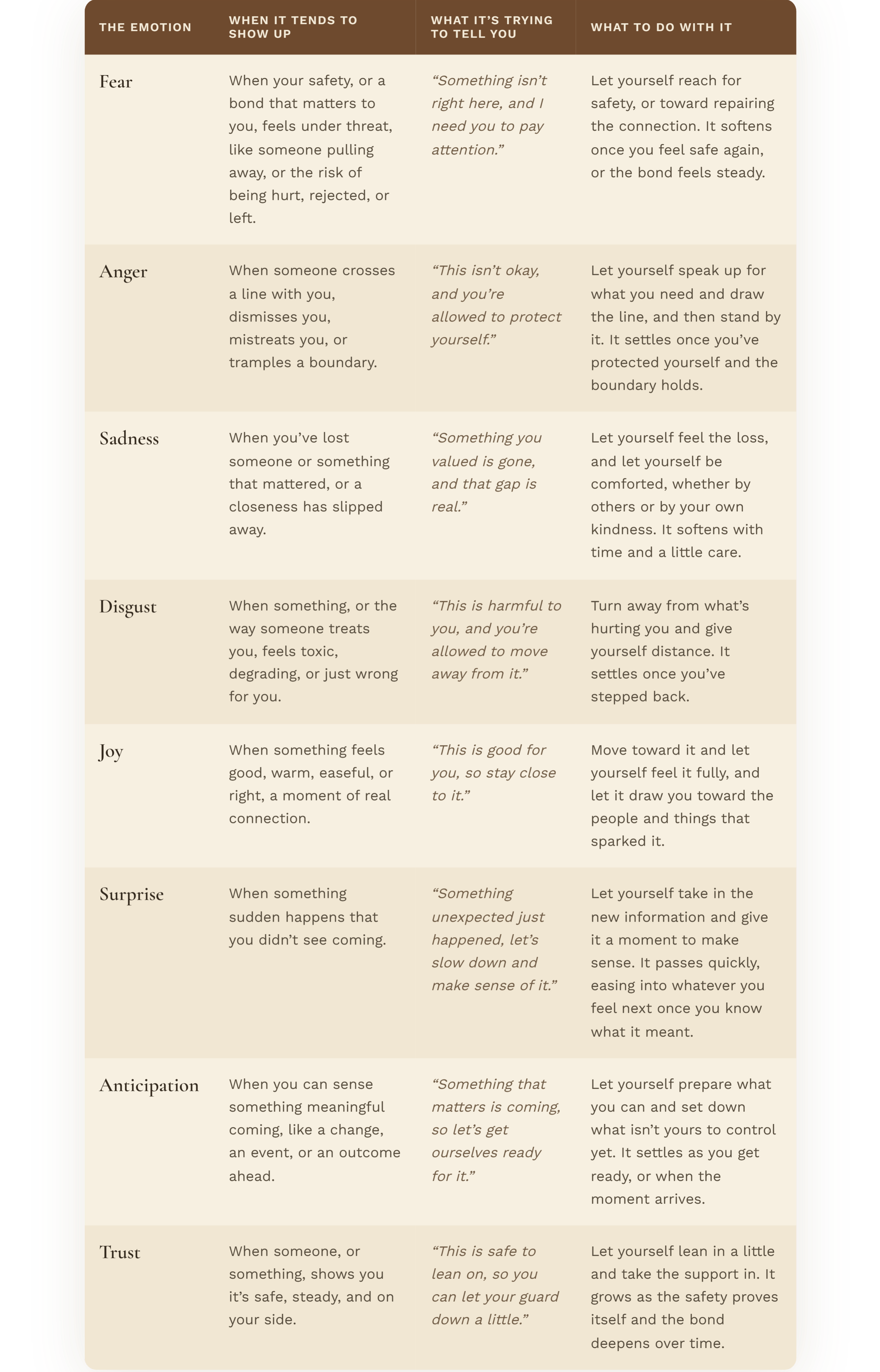
The examples here come from relationships, because that’s often where our feelings get the most tangled. The table here shows the postman at his best, the primary adaptive emotions, each arriving with a real message about what’s happening now. It also shows you how to receive the message: how to take the letter, read it, and act on what it says.
“Why do some feelings help me one moment and hurt me the next?”
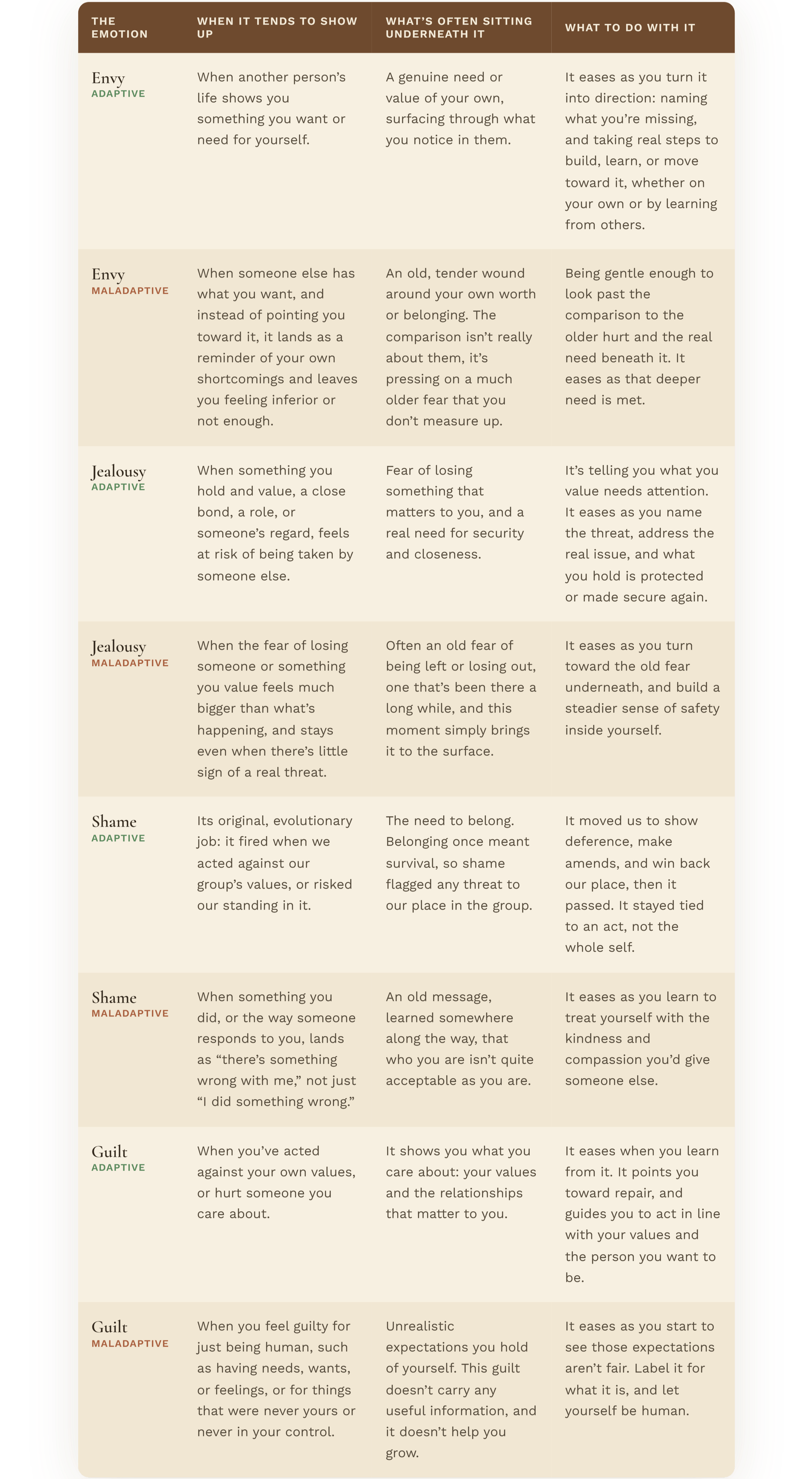
So far the postman has been doing his job. But sometimes the same knock at your door is a true message about now, and sometimes it’s old mail from long ago. These are the feelings that can go either way, adaptive or maladaptive. Adaptive is when the feeling fits the moment and guides you toward something real. Maladaptive is when it’s an old hurt resurfacing that keeps you stuck.
By now you might be thinking, dear god, how many emotions are there? Grab a cup of tea, because there’s one more, a big one we’ve all felt and mostly try to avoid: pain. Pain is another complicated emotion, one that can’t really be explained in a simple way, and it comes in more than one kind. If you ever feel stuck in it, where no matter what you do it doesn’t seem to ease, you might be caught in what’s called dirty pain. Clean pain is letting yourself feel the pain that’s actually there, even though it hurts. Dirty pain is our reaction to the pain: not wanting to feel it, fearing it, judging how we’re feeling it, or wanting it to be over. That’s the part that keeps us stuck. In our postman story, clean pain is opening the letter and reading it, and dirty pain is everything we do to avoid it, rush it, or blame ourselves for how we’re reading it.
So now I’ve got the whole map of emotions, I’m set for life, right?
If only, haha. I really wish I could say yes, but here’s the tricky part: any feeling can wear the face of another. It’s often hard to tell whether what you’re feeling is the real thing about now, an old feeling from before, or a reaction to something else entirely. Sometimes you won’t know if it’s the postman, the postman with old mail, or the salesperson at your door. That’s why feelings get so tangled, and it isn’t a flaw in you.
Telling them apart is a skill, and no one learns it overnight. It takes time, patience, and kindness toward yourself. And you were never meant to work it all out alone.
References
Ekman, P. (1992). An argument for basic emotions. Cognition and Emotion, 6(3–4), 169–200.
Frijda, N. H. (1986). The emotions. Cambridge University Press.
Gilbert, P. (1997). The evolution of social attractiveness and its role in shame, humiliation, guilt and
therapy. British Journal of Medical Psychology, 70(2), 113–147.
Gilbert, P. (2003). Evolution, social roles, and the differences in shame and guilt. Social Research, 70(4),
1205–1230.
Greenberg, L. S. (2002). Emotion-focused therapy: Coaching clients to work through their feelings.
American Psychological Association.
Greenberg, L. S., & Safran, J. D. (1987). Emotion in psychotherapy: Affect, cognition, and the process of
change. Guilford Press.
Hayes, S. C., Strosahl, K. D., & Wilson, K. G. (1999). Acceptance and commitment therapy: An experiential
approach to behavior change. Guilford Press.
Lewis, H. B. (1971). Shame and guilt in neurosis. International Universities Press.
Plutchik, R. (1980). Emotion: A psychoevolutionary synthesis. Harper & Row.
Schwartz, R. C., & Sweezy, M. (2020). Internal family systems therapy (2nd ed.). Guilford Press.
Tangney, J. P., & Dearing, R. L. (2002). Shame and guilt. Guilford Press.
Tangney, J. P., Stuewig, J., & Mashek, D. J. (2007). Moral emotions and moral behavior. Annual Review of
Psychology, 58, 345–372.
Van de Ven, N., Zeelenberg, M., & Pieters, R. (2009). Leveling up and down: The experiences of benign
and malicious envy. Emotion, 9(3), 419–429.
Young, J. E., Klosko, J. S., & Weishaar, M. E. (2003). Schema therapy: A practitioner’s guide. Guilford
Press.
